
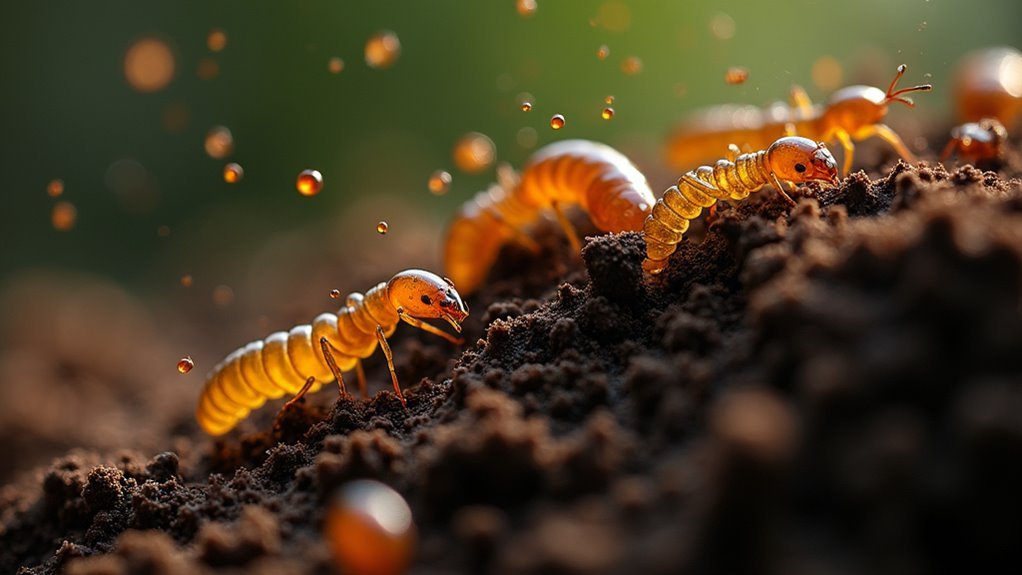
Beneficial nematodes struggle against termites because they can’t penetrate the structural barriers that protect established colonies. You’ll find that painted surfaces, dense wood fibers, and deep underground tunnels block nematode access to their targets. Environmental factors like cold temperatures, improper soil moisture, and pH imbalances quickly kill nematode populations before they reach termite larvae. Termites also retreat deeper when threatened, avoiding contact entirely. Understanding these limitations reveals why alternative approaches often prove more reliable.
Understanding How Beneficial Nematodes Target Termite Colonies
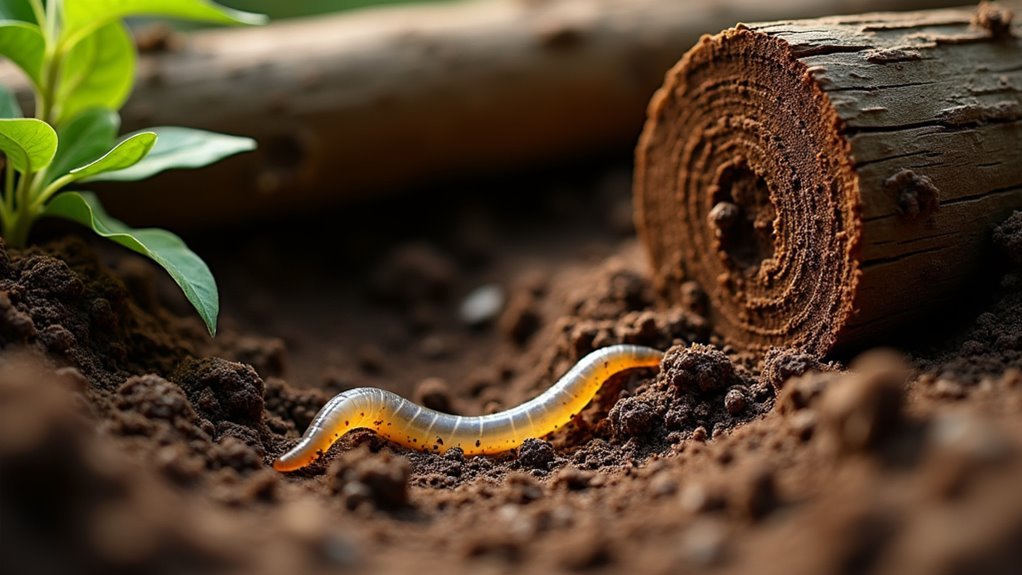
When you’re dealing with termite problems, beneficial nematodes like Steinernema carpocapsae and Heterorhabditis bacteriophora offer a targeted biological solution that works by infiltrating termite colonies and infecting larvae with deadly bacteria.
These microscopic roundworms actively seek out termite larvae within the colony structure, delivering fatal bacterial payloads that kill their hosts from within.
You’ll find that this biological control method specifically targets the vulnerable larval stage of termites rather than adult workers or reproductives.
However, you’re facing significant challenges when applying this approach to real-world termite infestations.
The specialized bacteria carried by nematodes requires precise conditions to remain effective, and the nematodes themselves need ideal environmental factors to successfully locate and penetrate termite colonies throughout your property’s affected areas.
Environmental Factors That Limit Nematode Effectiveness
Although beneficial nematodes show promise as a biological termite control method, several environmental factors can severely limit their effectiveness in real-world applications.
Temperature constraints pose a significant challenge, as nematodes require soil temperatures exceeding 52°F for ideal performance, making them unsuitable for colder climates or winter applications.
Nematodes need soil temperatures above 52°F to work effectively, limiting their use in cold weather conditions.
Critical environmental barriers include:
- Moisture levels – Both excessive dryness and oversaturation can drastically reduce nematode survival rates and their ability to locate termite populations effectively.
- Soil salinity – High salt concentrations in soil directly compromise nematode viability and reproduction capabilities.
- Competing microorganisms – Dense microbial activity creates hostile environments where nematodes struggle to establish colonies.
These environmental factors often combine to create conditions where even properly applied nematodes can’t deliver reliable termite control results.
Structural Barriers That Prevent Nematode Access to Termites
Beyond environmental challenges, physical obstacles within structures create substantial barriers that prevent nematodes from reaching their termite targets.
You’ll find that termites typically inhabit deep, hard-to-reach areas within wood structures where nematodes can’t easily penetrate. The dense wood fibers create physical barriers that block nematode movement, severely limiting their ability to locate termite colonies.
When you apply nematodes to treated wood surfaces, paint, varnish, and sealants repel these beneficial organisms before they can make contact with termites.
These structural barriers make traditional nematode applications largely ineffective against established infestations. You’re fundamentally trying to fight termites through layers of protection that shield them from biological control methods, forcing you to contemplate alternative approaches for successful termite management.
Soil Conditions That Compromise Nematode Survival
While nematodes show promise as biological control agents, their survival depends heavily on specific soil conditions that you can’t always control or maintain.
Your beneficial nematodes need soil temperatures above 52°F to remain viable, but cold weather can quickly eliminate entire populations.
Several environmental factors can sabotage your nematode application:
- Moisture extremes – High soil moisture levels create saturated conditions that kill nematodes, while drought stress also reduces their survival rates.
- Chemical imbalances – Soil pH levels outside the neutral to slightly acidic range compromise nematode viability and reproduction.
- Physical barriers – Compacted soil prevents nematode movement, limiting their ability to locate termite targets effectively.
Excessive organic matter and competing microorganisms further interfere with nematode establishment, making successful termite control unpredictable.
Termite Behavior Patterns That Reduce Nematode Contact
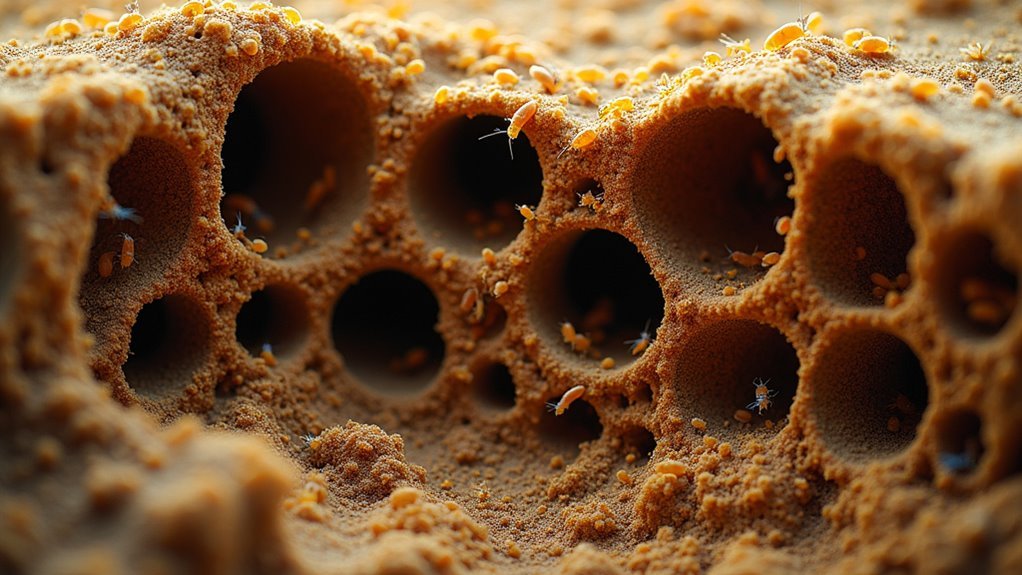
Even when soil conditions favor nematode survival, termite behavior creates significant barriers that prevent effective contact between these biological control agents and their targets.
You’ll find that subterranean termites naturally avoid light and remain deep underground in dark, moist tunnels where nematodes struggle to penetrate effectively. When these insect pests detect threats, they’ll retreat even deeper into their colonies, minimizing exposure to biological control attempts.
The massive size of termite colonies compounds this challenge – you’re dealing with thousands of individuals spread across extensive tunnel networks that limited nematode applications simply can’t reach thoroughly.
Additionally, as aging wood becomes increasingly attractive to termites, their accelerated feeding behavior reduces the window of opportunity for nematodes to establish successful contact and infection.
Alternative Natural Methods When Nematodes Fall Short
When nematodes can’t establish effective contact with termite colonies, you’ll need to explore alternative natural methods that bypass the behavioral barriers these pests create.
Unlike beneficial nematodes that require direct contact, these environmentally friendly approaches work through different mechanisms to eliminate termites without resorting to harsh chemical treatments.
While nematodes need direct contact to work, alternative natural methods use different approaches to eliminate termites without chemical pesticides.
- Temperature extremes – Heat treatment raises infested areas to lethal levels while consistent freezing eliminates colonies.
- Natural compounds – Essential oils like clove and neem contain insecticidal properties that poison termites on contact.
- Physical barriers – Diatomaceous earth damages exoskeletons, causing dehydration and death.
You can also utilize sunlight exposure, as these photosensitive insects die under direct sunlight.
Boric acid offers another option, disrupting termite digestive systems upon ingestion for effective long-term control.
Frequently Asked Questions
Will Beneficial Nematodes Kill Termites?
You’ll find that beneficial nematodes can kill termites, particularly species like Steinernema carpocapsae. However, they won’t provide complete control due to termite colony size and structure, requiring additional pest management methods.
Is There a Downside to Beneficial Nematodes?
You’ll face several downsides with beneficial nematodes: they’re ineffective against large termite populations, struggle with delivery challenges, depend on specific environmental conditions, and die after eliminating pests, limiting long-term control.
What Is the Number One Termite Killer?
You’ll find professional pest control services are the number one termite killer. They combine chemical treatments like imidacloprid with biological agents, achieving over fifty percent mortality rates through targeted, thorough approaches.
How Long Does It Take Beneficial Nematodes to Kill Grubs?
You’ll see beneficial nematodes kill grubs within 24 to 48 hours after infection. They enter the grub’s body, release deadly bacteria, and cause death within just a few days.
In Summary
You’ve learned that beneficial nematodes don’t always deliver the termite control you’re expecting. Environmental challenges, soil barriers, and termite behavior patterns can severely limit their effectiveness. Don’t abandon biological control entirely—you’ve got other natural options like diatomaceous earth, beneficial fungi, and borax-based treatments. Understanding these nematode limitations helps you make smarter pest control decisions and choose methods that’ll actually work in your specific situation.


Leave a Reply