You’ve probably noticed that suspicious scratching in your walls or those tiny droppings in your pantry. By the time these signs appear, pests have already made themselves at home. Early detection is your best defense, but you’ll need the right tools to spot infestations before they become full-blown problems. The difference between a minor issue and a costly nightmare often comes down to timing and equipment. So what exactly should you have in your pest prevention arsenal?
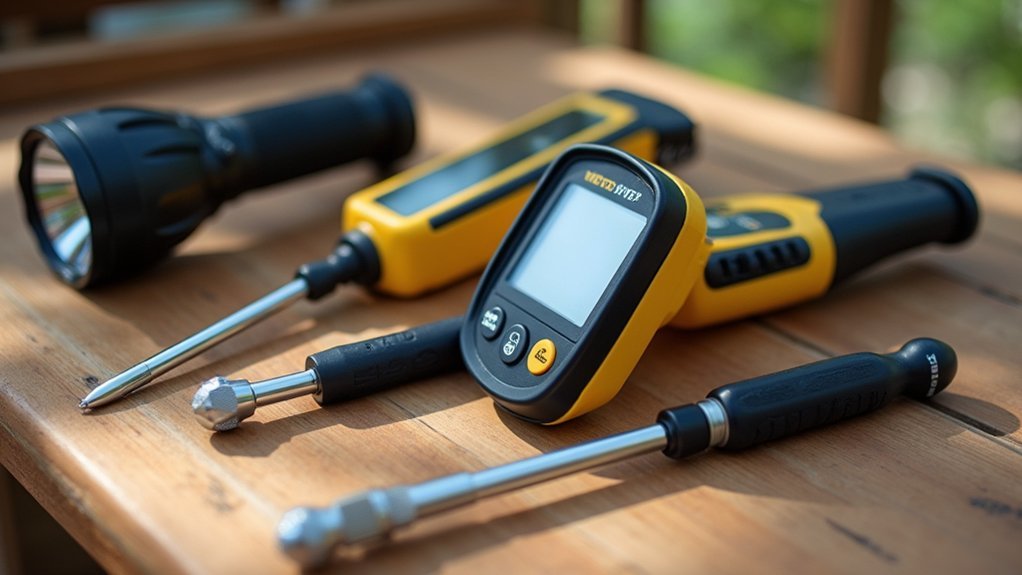
Klein Tools Home Inspector Tool Kit with Digital Moisture Meter
Professional pest inspectors need reliable detection equipment, and this thorough kit delivers. You’ll get three essential tools that help identify potential pest entry points and conducive conditions.
The digital moisture meter uses EMF technology to detect dampness up to 3/4-inch deep in drywall without causing damage—perfect for finding water issues that attract pests. The non-contact voltage tester (50-1000V) helps you check electrical systems where pests might hide.
For complete inspections, the GFCI outlet tester identifies wiring problems that could create unsafe conditions. All tools are CAT IV 1000V rated for your safety during thorough pest assessments.
Best For: Professional pest inspectors and home inspectors who need to identify moisture problems, electrical issues, and potential pest entry points without causing damage to structures.
Pros:
- Non-destructive moisture detection using EMF technology helps identify water issues that attract pests without damaging walls
- Comprehensive kit includes three essential tools (moisture meter, voltage tester, and GFCI tester) for thorough inspections
- CAT IV 1000V safety rating ensures protection when working around electrical systems
Cons:
- Moisture meter limited to 3/4-inch depth detection in drywall, which may miss deeper moisture problems
- Focused primarily on electrical and moisture detection rather than providing a complete pest inspection solution
- May require additional specialized tools for comprehensive pest-specific detection and identification
Larger Areas Pest A Cator 2000 Electromagnetic Rodent Repeller F
Homeowners with spaces up to 2000 square feet will find the Pest A Cator 2000 Electromagnetic Rodent Repeller an innovative solution for rodent problems. This beige device plugs into any 110V outlet and works by sending silent pulsing signals through your home’s wiring to repel mice and rats.
You’ll appreciate its maintenance-free operation—no traps to empty or chemicals to replace. It’s safe around children and pets (except rodent pets). For multi-story homes, you’ll need multiple units. Many customers report mice disappearing within days of installation, though it works best as part of an integrated pest management approach.
Best For: Homeowners with spaces up to 2000 square feet seeking a maintenance-free, child and pet-safe solution to rodent problems without using traps or chemicals.
Pros:
- Covers large areas up to 2000 square feet with electromagnetic technology that works through existing home wiring
- Completely maintenance-free operation with no traps to empty or chemicals to replace
- Safe to use around children and pets (except rodent-type pets)
Cons:
- Multiple units required for larger spaces or multi-story homes, adding to the cost
- Not a standalone solution – works best as part of an integrated pest management approach
- Some users report diminished effectiveness if too many units are used in close proximity
Inspectors Field Guide for Pest Identification
The Inspectors Field Guide for Pest Identification serves as an essential companion for technicians in the field, offering a handy flip book format that simplifies on-the-spot pest recognition.
You’ll find detailed descriptions of common pests, with particular strength in identifying pantry pests and flies. When interacting with customers, this guide becomes invaluable—showing photos and specifics that help close sales contracts.
While users generally praise its utility as a starting point and study resource for applicator licensing, some wish for more thorough coverage. Many technicians have expressed interest in purchasing additional pages or volumes to expand this practical reference tool.
Best For: Pest control technicians who need a practical field reference for common pest identification during customer visits and sales presentations.
Pros:
- Provides detailed descriptions and visuals that effectively help identify common pests, especially pantry pests and flies
- Serves as a useful study guide for technicians pursuing their applicators license
- Enhances customer interactions with visual aids that help explain pest issues and close sales contracts
Cons:
- Some users find the guide lacks the comprehensive depth needed for more definitive identification
- Limited in scope compared to what some technicians need for complete field coverage
- No clear path for expanding the guide with additional pages or volumes despite user interest
Ultrasonic Pest Repeller, Electronic Pest Control for Indoor Use
Environmentally-conscious homeowners seeking a chemical-free solution will find Neatmaster’s Ultrasonic Pest Repeller particularly appealing. This modern device targets roaches, mice, spiders, and other pests without harmful chemicals or messy traps.
You’ll appreciate the three operation modes—indicated by colored lights—that address different infestation levels. For ideal results, place units in multiple rooms, as ultrasonic waves don’t penetrate walls. While you won’t see immediate results, expect significant improvement within 3-4 weeks of continuous use.
The compact 4.7 × 3.3 × 2.3-inch design covers 800-1200 square feet, making it suitable for most home spaces.
Best For: Environmentally-conscious homeowners seeking a chemical-free pest control solution for roaches, mice, spiders, and other common household pests without using poisons or traps.
Pros:
- Uses multiple wave technologies (bionic, electromagnetic, and ultrasonic) to create an uncomfortable environment for pests without killing them
- Features three operation modes (green, blue, and red) to address different levels of pest infestation
- Compact design covers 800-1200 square feet with no chemicals, making it safe for homes with children and pets
Cons:
- Requires 3-4 weeks of continuous use before noticeable results appear
- Ultrasonic waves cannot penetrate walls, requiring multiple units for whole-home protection
- Some users report the sound levels at medium and high settings may disturb pets or sensitive individuals
Ultrasonic Pest Repeller, Electronic Plug-in Pest Control for Insects
Pest-conscious individuals who seek non-toxic solutions will find the Neatmaster Ultrasonic Pest Repeller an appealing alternative to traditional pest control methods. This device utilizes bionic, electromagnetic, and ultrasonic waves to repel various pests including mice, roaches, and mosquitoes.
You’ll appreciate its simple operation with three settings—Green (low), Blue (medium), and Red (high)—to combat different infestation levels. Covering up to 1200 square feet, you won’t need chemicals or traps. Be patient, as results typically take 3-4 weeks to materialize. While customer experiences vary, many report significant reductions in pest activity. Remember that ultrasonic waves can’t penetrate walls, so consider multiple units for extensive coverage.
Best For: Environmentally-conscious homeowners seeking a chemical-free, humane pest control solution for moderate pest problems in single rooms or open living spaces.
Pros:
- Completely non-toxic and safe for households with children, pets, or health-sensitive individuals
- Simple plug-and-play operation with three intensity settings to address different infestation levels
- No dead pests to clean up, creating a hassle-free pest management experience
Cons:
- Limited effectiveness as ultrasonic waves cannot penetrate walls, requiring multiple units for whole-home coverage
- Results take 3-4 weeks to become apparent, not ideal for immediate pest control needs
- Mixed effectiveness against certain pests like moths and lizards, with some reports of devices malfunctioning after a month
Factors to Consider When Choosing Pest Inspection Tools for Early Detection and Prevention
When choosing pest inspection tools, you’ll need to evaluate whether they offer moisture detection capabilities to identify conditions that attract pests. Consider if electronic tools with automated scanning fit your needs better than manual tools, and guarantee the device covers an adequate area for your property size. You should also check power source requirements for portability and confirm the tools meet safety certification standards to protect your household.
Moisture Detection Capabilities
The ability to detect hidden moisture serves as a critical factor in effective pest management, since many destructive pests are naturally drawn to damp environments. When selecting pest inspection tools, prioritize those with advanced moisture detection capabilities that can penetrate materials up to 3/4-inch deep, particularly for inspecting drywall and other vulnerable building materials.
Look for non-destructive moisture meters that won’t damage your property while still providing accurate readings of concealed moisture issues. These tools enable you to identify potential pest hotspots before infestations take hold. By incorporating regular moisture assessments into your inspection routine, you’ll not only prevent structural damage but also reduce the likelihood of pest problems. This proactive approach ultimately saves you money on both pest control services and costly repairs.
Electronic vs. Manual Tools
Choosing between electronic and manual pest inspection tools often depends on your specific needs and the nature of potential infestations. Electronic options like ultrasonic repellers use sound waves to cover large areas—up to 2000 square feet with a single device—while manual tools require multiple units for similar coverage.
Consider your timeline when deciding. Electronic methods typically take 3-4 weeks to reach full effectiveness, whereas manual traps deliver immediate results. If you’re looking for low maintenance solutions, electronic devices win with minimal upkeep and no messy pest disposal. Manual options require regular checking and cleanup of trapped pests.
Safety is another significant factor, especially if you have children or pets. Electronic tools offer chemical-free pest control, while some manual methods may present risks depending on their design and implementation.
Coverage Area Effectiveness
Understanding coverage area capabilities represents one of the most critical factors in selecting effective pest inspection tools. Most ultrasonic repellers cover up to 1,200 square feet, which is suitable for standard living spaces, while electromagnetic rodent repellers can effectively protect up to 2,000 square feet, making them ideal for larger homes or multi-story buildings.
You’ll need to match your tool’s coverage to your space’s dimensions. For complex layouts or larger properties, you might need multiple units strategically placed for extensive protection. Remember that a tool’s construction materials affect its ability to penetrate walls and barriers, potentially limiting its effectiveness in certain areas.
Don’t overlook the importance of regular monitoring. Even with appropriate coverage, you should periodically check your tools’ effectiveness, as pest populations can fluctuate seasonally.
Power Source Requirements
Three main power options define your pest inspection tool choices: battery-operated, plug-in, and solar-powered systems. Each option impacts how and where you’ll effectively deploy your monitoring solutions.
Battery-operated devices offer unmatched portability, allowing you to place them anywhere regardless of outlet availability. However, you’ll need to factor in regular battery replacements for consistent performance. Plug-in tools eliminate this concern by providing continuous, reliable operation—ideal for long-term monitoring stations where power outlets are accessible.
For remote or outdoor settings, consider solar-powered alternatives that harness natural energy. Remember to evaluate each tool’s power consumption, as high-demand devices considerably increase operational costs over time. Always match your power source to your specific environment—residential settings with standard outlets require different solutions than remote agricultural or wilderness applications.
Safety Certification Standards
Reliable pest inspection tools must meet stringent safety certification standards to protect both operators and property. When selecting equipment, look for CAT IV 1000V electrical safety ratings on tools that might encounter high voltage during inspections, especially in crawl spaces or near electrical systems.
Verify that your tools display certification marks from recognized organizations like Underwriters Laboratories (UL) or the International Electrotechnical Commission (IEC). These marks confirm the devices have undergone rigorous testing for safety and performance.
If you’ll be using inspection tools in homes with children or pets, choose equipment specifically certified for residential use. Additionally, make certain any pest detection devices comply with EPA guidelines to avoid environmental hazards or health risks. These certifications aren’t just formalities—they’re vital safeguards that prevent accidents while you’re conducting thorough inspections.
Multi-Function Detection Features
Multi-function detection tools represent the next evolution in pest inspection technology, building upon the safety foundations we’ve just explored. These versatile devices combine moisture detection, voltage testing, and GFCI verification in one compact unit, streamlining your inspection process and saving valuable time.
You’ll gain extensive insights by identifying high-moisture areas—prime real estate for pests—while simultaneously checking for electrical issues that might create favorable pest conditions. Some advanced models even incorporate electromagnetic technology that repels pests while detecting problems, offering a two-pronged approach to prevention.
When selecting your tool, prioritize those measuring moisture content in building materials, as this capability helps pinpoint potential infestation sites before they develop. By investing in multi-function detection equipment, you’re equipping yourself to conduct faster, more thorough inspections that address both pest risks and underlying structural issues.
Portability and Size
The dimensions of your pest inspection tools can make or break your efficiency in the field. When selecting equipment, prioritize compact, lightweight options that won’t burden you during lengthy inspection sessions. Many modern tools, like ultrasonic pest repellers weighing just 3-4 ounces, offer impressive functionality without adding significant weight to your toolkit.
Consider how you’ll access tight spaces during inspections. Smaller moisture meters can reach confined areas where evidence of pest activity often hides. Additionally, plug-and-play designs eliminate complex setup procedures, allowing you to move quickly between inspection points.
This portability factor becomes especially essential if you’re a technician routinely carrying multiple devices between properties. The cumulative weight of your equipment directly impacts your mobility and stamina throughout the workday.
Technology Integration Options
Technology integration has elevated pest inspection from simple manual checks to sophisticated detection systems. You’ll find electromagnetic and ultrasonic wave devices that effectively repel various pests without chemicals or traps. Digital moisture meters identify dampness in building materials, helping you spot potential pest habitats before infestations begin.
Safety is enhanced with non-contact voltage testers that let you check for live wires during inspections without risking electrical hazards. Many modern tools employ bionic and electromagnetic technologies to create environments that pests find uncomfortable, preventing problems before they escalate.
For maximum effectiveness, consider combining detection and repellent technologies in your toolkit. This thorough approach enables you to both identify existing issues and prevent future infestations, making your pest management strategy more robust and sustainable.
Frequently Asked Questions
How Often Should Professional Pest Inspections Be Scheduled?
You should schedule professional pest inspections annually for preventive maintenance. If you’re in high-risk areas or notice signs of infestation, increase frequency to quarterly. Don’t wait until pests become a visible problem.
Can DIY Pest Inspection Replace Professional Services?
DIY pest inspections can’t fully replace professional services. While you’ll catch obvious issues, professionals have specialized tools, training, and experience to detect hidden infestations early. Consider DIY as supplemental between professional visits.
Are Pest Inspection Tools Covered by Home Insurance?
Most home insurance policies don’t cover pest inspection tools. You’ll need to purchase these items yourself, but consider them a worthwhile investment compared to the cost of dealing with infestations later.
Which Pests Are Hardest to Detect With Standard Tools?
You’ll find termites, bed bugs, and carpenter ants most challenging to detect with standard tools. They’re masters at hiding in walls, furniture, and wood structures until infestations become severe and obvious.
How Do Seasonal Changes Affect Pest Inspection Procedures?
You’ll need to adapt your inspections seasonally. Summer requires checking attics for heat-loving pests, while winter demands focus on basements where pests seek warmth. Spring and fall bring unique migration patterns to monitor.



Leave a Reply