
You’ll stop flies most effectively by targeting their rapid 8-10 hour life cycle through seasonal strategies. Focus spring efforts on eliminating breeding sites and managing manure before populations explode. During summer, use natural deterrents like lavender and basil plants, plus essential oil sprays for immediate protection. Fall cleanup removes overwintering habitats, while year-round trap systems and diatomaceous earth applications maintain control. Understanding these targeted approaches transforms your fly problem into a manageable seasonal routine.
Understanding Fly Life Cycles and Seasonal Patterns
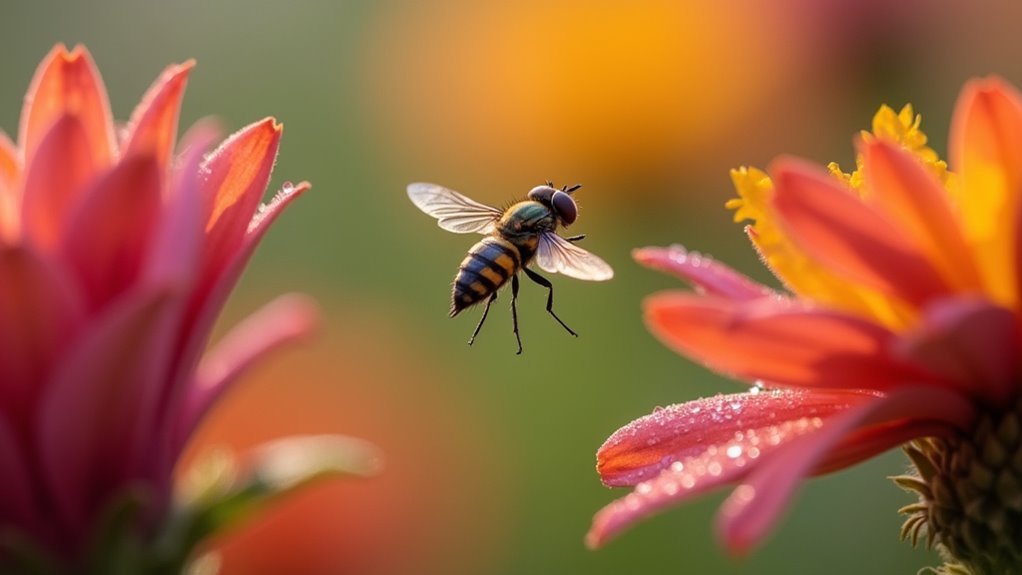
While most people notice flies buzzing around their property during summer months, the reality is that these persistent pests follow predictable patterns that you can anticipate and disrupt.
Flies complete their entire life cycle in just 8-10 hours under ideal conditions, making swift action essential for effective control. During peak season, you’re dealing with insects that lay 3,000 to 6,000 eggs every 3-4 days, creating explosive population growth when temperatures rise.
Flies reproduce at lightning speed—up to 6,000 eggs every few days—demanding immediate intervention before populations spiral out of control.
The numbers are staggering: a single pair of flies can generate 191 quadrillion offspring in four months. Understanding these seasonal spikes allows you to implement proactive measures before populations explode.
Since flies carry over 1,000 different pathogens, disrupting their reproductive cycles protects your family’s health and prevents infestations from overwhelming your property.
Spring Prevention: Eliminating Breeding Sites Before Peak Season
Spring presents your best opportunity to stop fly populations before they explode into unmanageable numbers. With flies laying 3,000 to 6,000 eggs every 3-4 days, you must act quickly to eliminate breeding sites.
Focus on manure management first, as accumulated waste creates the moist environments flies need to reproduce. Clean outdoor areas thoroughly, removing food remnants and debris that attract flies. Establish proper drainage systems to prevent moisture buildup in your yard.
Consider spreading diatomaceous earth in areas where manure accumulates to create drier conditions.
- Target moisture sources immediately – wet manure and standing water are prime breeding grounds
- Clean food debris weekly before it attracts egg-laying females
- Install drainage systems to eliminate waterlogged soil conditions
- Apply diatomaceous earth monthly in high-risk areas for ongoing protection
Natural Plant-Based Deterrents for Summer Protection

Why rely on harsh chemicals when nature provides powerful fly deterrents that work throughout summer’s peak infestation months?
You’ll find several plant-based solutions that effectively repel and capture flies while enhancing your home’s appeal.
Plant lavender near entryways or display fresh bouquets indoors to naturally deter flies with its pleasant aroma.
Lavender’s natural fragrance creates an effective barrier against flies while adding beauty and pleasant scents to your living spaces.
Basil serves double duty in your kitchen, providing culinary herbs while emitting scents that repel pests.
For active fly control, Venus flytraps consume five to ten bugs monthly, making them excellent for managing indoor populations.
Pitcher plants capture one to two bugs every two to four weeks, offering superior control for heavier infestations.
Create your own repellent spray by mixing ten drops of peppermint or lavender essential oil with two cups each of water and non-flavored vodka.
Essential Oil Sprays and Homemade Repellent Recipes
Although commercial repellents often contain synthetic chemicals, you can create equally effective fly deterrents using essential oils and common household ingredients.
Essential oil sprays work exceptionally well when you mix ten drops of peppermint, lavender, thyme, cinnamon, or lemon oil with two cups each of water and non-flavored vodka. You’ll find cayenne pepper equally effective—simply combine one teaspoon with one cup of water for entryway protection.
For trap-style solutions, mix apple cider vinegar with dish soap in a tall glass, cover with plastic wrap, and poke holes for entry points.
Alternatively, dilute one tablespoon of Dr. Bronner’s liquid soap in one quart of water for a peppermint-scented spray.
- Essential oils provide natural, chemical-free protection for your family
- Household ingredients offer cost-effective alternatives to expensive commercial products
- Multiple application methods target different fly behaviors and preferences
- Fresh herb combinations extend protection while adding pleasant natural fragrances
Effective Trap Systems for High-Traffic Areas

When flies overwhelm your outdoor gatherings and work spaces, strategic trap placement becomes your most powerful defense against persistent infestations. You’ll need bag-type fly traps for patios and barns, where they’ll capture large numbers effectively. Sticky paper traps work perfectly in strategic locations without chemicals, maintaining a cleaner environment.
| Trap Type | Best Location | Key Benefit |
|---|---|---|
| Bag Traps | Patios/Barns | High Capacity |
| Sticky Paper | Strategic Points | Chemical-Free |
| Advanced Systems | Entry Points | Behavior-Based |
| Outdoor Fans | Gathering Areas | Air Movement |
Don’t underestimate outdoor fans – they’ll create airflow that deters flies from congregating. Replace traps regularly since fly populations rebound quickly; one pair can produce 191 quadrillion flies in four months. Consider advanced systems with behavior-based attractants for maximum effectiveness.
Manure Management and Diatomaceous Earth Applications
You’ll find that combining proper manure management with diatomaceous earth creates a powerful one-two punch against fly infestations.
By removing accumulated manure regularly and applying DE at 50g per 10m² in problem areas, you’re eliminating breeding sites while creating conditions that physically damage flies.
This weekly treatment approach doesn’t just reduce current populations—it breaks the reproductive cycle that keeps bringing new flies to your property season after season.
Proper Manure Management Practices
Since fly populations thrive in environments with accumulated organic waste, implementing proper manure management practices becomes your most effective first line of defense against seasonal fly infestations.
Regular removal and composting of manure greatly reduces breeding areas by minimizing organic waste accumulation. You’ll need to maintain consistent cleanup schedules and guarantee prompt attention to any spills from watering systems.
- Remove manure weekly – Regular removal prevents fly larvae development and eliminates prime breeding conditions
- Compost organic waste properly – Turn compost piles frequently to maintain heat levels that kill fly eggs and larvae
- Clean water spills immediately – Moisture combined with organic matter creates ideal fly breeding environments
- Maintain dry storage areas – Keep feed and bedding materials in well-ventilated, moisture-free zones
Diatomaceous Earth Application Methods
Food-grade diatomaceous earth offers a natural, chemical-free solution that complements your manure management efforts by targeting fly breeding sites directly.
Apply it at 50g per 10m² (1oz per 65sq ft) to create a drier environment that reduces fly breeding. Spread the powder in areas where manure accumulates, focusing on primary breeding sites. The abrasive particles lacerate insect exoskeletons, causing dehydration and reducing fly populations through consistent application.
You’ll need to apply diatomaceous earth weekly for best results. Expect to see noticeable effects within 5 to 6 weeks of regular treatments.
Weekly Treatment Schedule Benefits
When you establish a consistent weekly treatment schedule, your fly control strategy becomes remarkably more effective than sporadic applications.
You’ll maintain the drier conditions necessary to disrupt fly reproductive cycles while preventing new breeding sites from developing. The 50g per 10m² application rate guarantees adequate coverage without waste, and when combined with regular manure management, you’re creating an inhospitable environment for flies.
Your patience during the initial 5-6 week period pays off considerably as the cumulative effects build. This systematic approach doesn’t just control current fly populations—it prevents future infestations.
- Consistent moisture control disrupts breeding cycles more effectively than random treatments
- Economic protection reduces livestock stress and associated production losses
- Cumulative effectiveness builds over time, requiring patience for ideal results
- Enhanced animal welfare through reduced fly harassment and disease transmission risks
Fall Cleanup Strategies to Reduce Overwintering Populations
Fall preparation becomes critical for breaking the fly reproduction cycle before winter arrives.
You’ll need to focus on eliminating breeding sites, managing yard debris effectively, and maintaining clean manure areas to prevent flies from establishing overwintering populations.
These targeted cleanup strategies will greatly reduce the number of flies that survive to emerge next spring.
Remove Breeding Sites
As temperatures drop and flies prepare for winter dormancy, eliminating their breeding sites becomes your most effective defense against next year’s infestations.
Focus your fall cleanup efforts on removing organic waste that attracts egg-laying females. Clean up dog poop and food remnants immediately, as these create prime breeding conditions. Guarantee proper drainage throughout your yard to prevent moisture buildup where flies thrive.
Target these key breeding sites during your fall cleanup:
- Compost areas – Cover food scraps and maintain proper composting practices to minimize odors
- Overgrown vegetation – Trim back plants and remove debris that harbor fly eggs and larvae
- Wet zones – Address drainage issues and eliminate standing water sources
- Yard clutter – Rake leaves regularly and clear materials where flies overwinter
Yard Debris Management
Beyond targeting specific breeding sites, your extensive fall debris management strategy will determine how many flies survive winter in your yard.
Start by cleaning up fallen leaves and grass clippings regularly, as these materials create perfect breeding environments. Remove any containers or areas collecting rainwater since stagnant water attracts flies for reproduction.
Focus on properly disposing of organic waste through secure composting methods that minimize odors and prevent fly access. Trim overgrown vegetation and clear dense brush where flies hide during colder months.
Your thorough fall cleanup routine should eliminate potential habitats before winter arrives.
This all-encompassing approach considerably reduces overwintering fly populations, giving you a major advantage when warmer weather returns and pest activity naturally increases.
Manure Area Maintenance
Proper manure management becomes your most critical fall task since flies can lay 3,000 to 6,000 eggs every 3-4 days in these nutrient-rich environments.
You’ll need to clean and remove manure regularly from housing and pasture areas to eliminate breeding sites before winter arrives. Poor management now leads to explosive fly populations come spring.
Focus your drainage management around manure areas to prevent moisture buildup, as wet conditions help flies survive colder months.
Apply food-grade diatomaceous earth at 50g per 10m² in accumulation areas to create drier conditions that disrupt breeding cycles.
- Remove organic waste consistently throughout fall to prevent overwintering populations
- Implement proper composting or timely disposal methods for collected manure
- Maintain adequate drainage systems around all manure storage areas
- Apply diatomaceous earth treatments in high-accumulation zones regularly
Year-Round Maintenance Practices for Long-Term Control
While seasonal fly control measures provide temporary relief, establishing consistent year-round maintenance practices creates the foundation for permanent population reduction.
You’ll need to implement regular manure cleaning schedules, removing waste weekly to eliminate prime breeding sites.
Apply diatomaceous earth consistently in accumulation areas to maintain dry conditions that discourage reproduction.
Install proper drainage systems in outdoor spaces to prevent moisture buildup throughout all seasons.
Deploy fly traps continuously, rotating between bag-type and sticky paper varieties to maintain capture effectiveness.
Continuous trap deployment with alternating bag-type and sticky paper varieties ensures sustained fly capture rates throughout the year.
Combine chemical solutions like cyzmic AI bug concentrate with natural essential oil repellents for thorough coverage.
You’ll achieve long-term control by maintaining these practices consistently rather than responding reactively to seasonal population surges.
This proactive approach prevents establishment of breeding cycles.
Chemical Solutions and Professional-Grade Products for Severe Infestations
When standard prevention methods fail to control severe fly populations, chemical solutions and professional-grade products become necessary for achieving rapid population reduction.
Products like Cyzmic AI bug concentrate offer effective control when mixed in tank sprayers for even application across surfaces. You’ll need to apply these outdoor treatments monthly to maintain control and prevent re-infestation.
Wait until the spray dries completely before allowing pets and humans back into treated areas. These insecticides target both adult flies and larvae, disrupting breeding cycles for thorough population control.
- Monthly application schedule guarantees continuous protection against re-infestation throughout peak fly seasons
- Tank sprayer mixing provides uniform coverage across large outdoor areas and various surface types
- Adult and larval targeting breaks the reproductive cycle for long-term population management
- Combined approach strategy enhances effectiveness when used alongside traps and environmental modifications
Frequently Asked Questions
What Is the Best Thing to Keep Flies Away?
You’ll find essential oil sprays work best – mix peppermint, thyme, or lemon oils with water and vodka. Spray around entryways and gathering spots while maintaining cleanliness to eliminate breeding sites.
What Season Do Flies Go Away?
You’ll notice flies naturally disappear during fall and winter months when temperatures drop considerably. They become less active as cooler weather sets in, with most populations dying off until spring returns.
Why Do I Get Flies in My House Every Summer?
You get flies in your house every summer because increased temperatures and humidity create perfect breeding conditions. Food remnants, pet waste, and moist areas attract them, while rapid reproduction turns small problems into major infestations quickly.
How Do I Get Rid of Flies Once and for All?
You’ll eliminate flies by combining multiple strategies: use traps and monthly pest treatments, maintain cleanliness around food and waste, improve airflow with fans, and plant natural repellents like basil.
In Summary
You’ve got the tools to tackle flies year-round now. Start with spring prevention, use natural deterrents during summer peaks, and don’t skip fall cleanup. Remember, consistency’s key—you can’t just treat the problem once and forget about it. Keep your traps maintained, manage breeding sites regularly, and escalate to stronger solutions when needed. With this seasonal approach, you’ll dramatically reduce fly populations and enjoy a more comfortable outdoor space.



Leave a Reply