
You’ll need to start your mosquito defense when temperatures hit 50°F by eliminating standing water and installing traps before peak season. Apply larvicides monthly, maintain weekly water source inspections, and position traps 30 feet apart in shaded areas. Focus protection during dawn and dusk peak activity periods using DEET repellents and outdoor fans. Intensify treatments through summer with regular lawn maintenance, monthly larvicide applications, and mid-season strategy adjustments to discover thorough year-round protection methods.
Early Season Preparation: Setting Up Your Defense Before May

Before mosquitoes become the bane of your summer evenings, you’ll want to establish your defense strategy early in the spring. Early season preparation begins when temperatures approach 50°F, marking the start of increased mosquito activity.
Start by eliminating standing water from containers, birdbaths, and clogged gutters where mosquitoes breed. You’ll also need to maintain your yard by mowing grass regularly and trimming bushes to remove adult mosquito hiding spots.
Remove mosquito breeding grounds by draining standing water and eliminate hiding spots through regular lawn maintenance and bush trimming.
Effective mosquito control includes installing traps before peak season to disrupt breeding cycles.
Don’t wait until mosquitoes swarm—establish your protective barrier now with mosquito repellents, including botanical options.
These proactive steps will greatly reduce mosquito population before they become problematic, ensuring your summer outdoor activities remain enjoyable and bite-free.
Weekly Standing Water Elimination Tasks
You’ll need to establish a consistent weekly routine that targets the three main areas where mosquitoes breed around your property.
Start by emptying all water containers daily, cleaning your gutters weekly to prevent clogs, and systematically checking those easily forgotten spots where water accumulates.
This systematic approach guarantees you’re disrupting the mosquito life cycle before these pests can establish themselves in your yard.
Empty Water Containers Daily
While mosquitoes can transform from eggs to biting adults in just 7-14 days, you can break this cycle by emptying and cleaning water containers at least once a week.
You’ll need to empty water containers like pet bowls, birdbaths, and flowerpot saucers regularly since mosquitoes lay hundreds of eggs in even small amounts of standing water.
Don’t forget to inspect and drain clogged gutters, tire swings, and children’s toys left outside. These overlooked items often become prime mosquito breeding grounds.
Rain barrels require tight-fitting lids and screens to prevent mosquito access while preserving rainwater collection.
Schedule weekly property patrols to identify hidden standing water sources. This consistent approach will considerably reduce the mosquito population in your yard throughout summer.
Clean Gutters Weekly
Clogged gutters rank among the most overlooked mosquito breeding sites around your home, yet they’re often the most productive for these pests. Standing water trapped by debris creates perfect mosquito breeding conditions, allowing populations to explode rapidly.
Clean gutters weekly using a hose or specialized cleaning tool to remove leaves and blockages. This simple pest control measure will reduce mosquitoes considerably around your property.
| Gutter Maintenance Task | Frequency |
|---|---|
| Remove leaves and debris | Weekly |
| Check downspout drainage | Weekly |
| Inspect for water pooling | Weekly |
| Clean after heavy rainfall | Immediately |
| Verify proper water flow | Weekly |
Ensure downspouts direct water away from your foundation, preventing pooling areas that attract mosquitoes and maintaining the dry environment essential for effective mosquito control.
Check Hidden Water Sources
Beyond the obvious breeding sites, mosquitoes thrive in countless overlooked water sources scattered throughout your property.
You’ll need to check hidden water sources weekly to maintain effective mosquito control. Start by examining plant saucers under potted flowers, where standing water accumulates unnoticed.
Don’t forget birdbaths tucked behind shrubs or decorative containers nestled in garden corners.
Outdoor toys left in secluded areas often collect rainwater, creating perfect breeding grounds.
Check underneath tarps covering equipment, inside old tires stored against walls, and within buckets hidden behind sheds.
Even small bottle caps can harbor enough water for mosquito reproduction.
Make it your mission to eliminate standing water from these concealed locations.
Walk your entire property systematically, looking beyond obvious spots to discover where mosquitoes secretly multiply.
Monthly Yard Maintenance for Mosquito Prevention
Since mosquito activity correlates directly with seasonal temperature changes, you’ll need to adjust your yard maintenance strategy throughout the warmer months.
Effective mosquito management requires adapting your maintenance approach as temperatures rise and mosquito populations peak throughout summer.
In May, start regular lawn maintenance by mowing grass and trimming bushes to eliminate mosquito hiding spots.
June marks the beginning of your monthly treatment schedule—apply EPA-approved mosquito repellent and larvicides to any remaining standing water sources.
During July, establish a weekly routine of revitalizing water features like birdbaths and fountains to prevent egg development.
August requires intensified efforts with continuous outdoor barrier treatments around your property’s perimeter.
You’ll also want to take into account installing mosquito traps for additional population control during peak summer activity.
This systematic approach guarantees effective mosquito control throughout the entire season.
Dawn and Dusk Activity Management Strategies

You’ll face the highest mosquito activity during dawn and dusk when these pests emerge for their peak feeding times.
Planning your outdoor activities around these periods requires strategic timing and enhanced protection methods to minimize exposure.
Understanding when mosquitoes are most aggressive helps you implement targeted defenses that’ll keep you comfortable while enjoying your yard during these beautiful but challenging hours.
Peak Feeding Times
When twilight hours arrive, mosquitoes emerge from their daytime hiding spots and begin their most aggressive feeding behavior.
These peak mosquito feeding periods occur during dawn and dusk when conditions are ideal for their activity. You’ll face the highest bite risk during these times, making targeted protection essential.
Combat peak mosquito activity by applying repellent containing DEET or oil of lemon eucalyptus before heading outdoors.
Install outdoor fans on patios and decks—mosquitoes are weak fliers and struggle against airflow.
Keep mosquitoes away by timing your outdoor activities strategically, scheduling events for later evening or earlier morning hours.
Deploy mosquito traps or misting systems specifically during these twilight periods to target them when they’re most vulnerable and active.
Outdoor Activity Planning
Although mosquitoes dominate dawn and dusk hours, strategic outdoor activity planning lets you reclaim your yard while minimizing bite exposure.
Schedule your outdoor gatherings during mid-morning or early afternoon when mosquito activity drops considerably. This simple timing shift dramatically reduces your family’s bite risk while maximizing enjoyment.
When you can’t avoid peak mosquito hours, implement these protective measures:
- Set up outdoor fans in seating areas to disrupt mosquitoes’ flight patterns and create comfortable airflow.
- Apply DEET-based insect repellent and wear long-sleeved clothing for maximum skin protection.
- Install mosquito traps strategically around your yard’s perimeter to catch mosquitoes before they reach your gathering space.
Regular lawn maintenance like mowing and bush trimming eliminates hiding spots, making your yard less attractive to mosquitoes year-round.
Enhanced Protection Methods
Dawn and dusk hours demand more aggressive protection strategies since these peak mosquito periods can’t always be avoided. You’ll need layered mosquito control approaches to keep your yard comfortable during these critical times.
| Protection Method | Application Time | Effectiveness Duration |
|---|---|---|
| DEET Repellent | 15 minutes before exposure | 4-6 hours |
| Outdoor Fans | Continuous during peak hours | Immediate area only |
| Mosquito Traps | 30 minutes before dusk | 24-48 hours |
| Misting Systems | Dawn/dusk activation | 2-4 hours |
Strategic placement of outdoor fans disrupts flight patterns when you can’t avoid these active periods. Regular lawn maintenance eliminates hiding spots that mosquitoes use during peak activity. These control tips work together to repel mosquitoes effectively and prevent mosquito encounters during unavoidable outdoor time.
Larvicide Application Schedule for Problem Areas
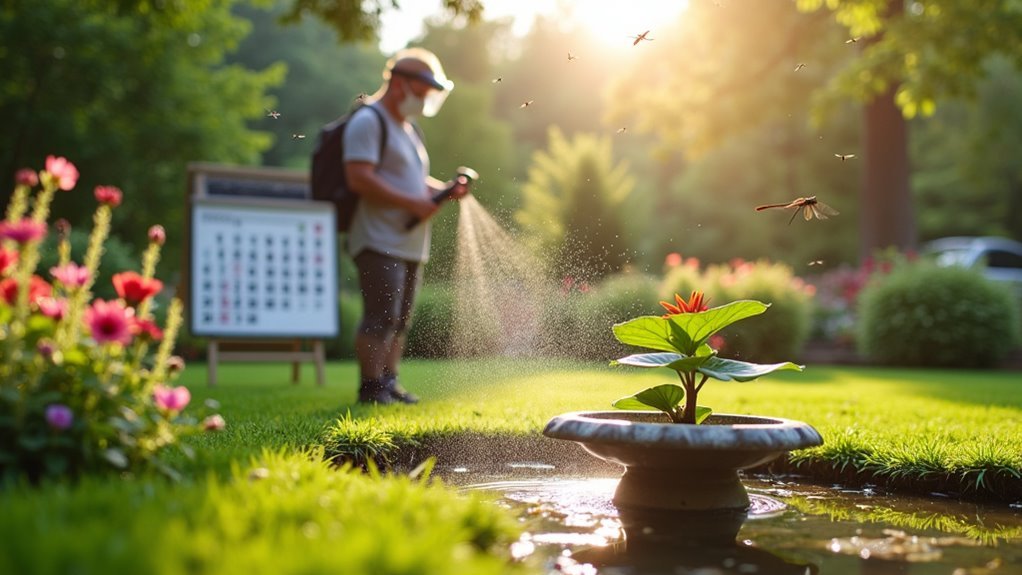
Since mosquito larvae develop rapidly in stagnant water during warm weather, you’ll need to establish a consistent larvicide application schedule to break their breeding cycle before adult populations explode.
Begin your applications in early spring when temperatures consistently exceed 50°F. This prevents mosquito populations from establishing as they emerge from hibernation.
Target all standing water sources including birdbaths, clogged gutters, and stagnant ponds where mosquitoes create their primary breeding grounds.
Follow this essential schedule:
- Apply every 30 days during peak season to eliminate larvae before they mature into biting adults.
- Use EPA-approved larvicides that won’t harm pets, birds, or beneficial aquatic life.
- Monitor weather patterns and increase frequency after heavy rainfall when new breeding grounds form.
Adjust your timing based on local mosquito activity for maximum effectiveness.
Trap Placement and Monitoring Timeline
While larvicide applications target mosquito breeding grounds, mosquito traps provide your second line of defense by capturing adult mosquitoes before they can reproduce.
Start your trap placement when temperatures consistently exceed 50°F, typically early May. Position traps in shaded areas near standing water sources, maintaining 30-foot spacing for ideal coverage.
Position mosquito traps in shaded areas near water sources with 30-foot spacing when temperatures consistently exceed 50°F in early May.
Your monitoring timeline should include weekly catch rate assessments throughout mosquito season. If catches drop considerably, relocate traps to higher-activity areas.
Maintain continuous operation since consistent running disrupts breeding cycles most effectively.
Enhance performance with EPA-registered regional attractants, which can increase catch rates up to 10 times for local species.
This systematic approach to mosquito traps and monitoring timeline guarantees maximum protection when integrated with your existing mosquito control strategy.
Mid-Season Assessment and Strategy Adjustments
By mid-June, you’ll need to reassess your mosquito control efforts and make strategic adjustments based on changing conditions.
A thorough mid-season inspection helps identify new challenges and optimize your mosquito control strategy for peak summer months.
Here’s your assessment checklist:
- Inspect for new standing water sources – Check clogged gutters, containers, and areas where water accumulates after recent landscaping changes.
- Evaluate current repellent effectiveness – Consider adding secondary attractants like Octenol to boost trap performance up to 10 times.
- Increase frequency of treatments – Step up trap placements and monitoring as mosquito activity rises during peak breeding season.
If you notice significant population increases despite your efforts, schedule professional mosquito control services.
They’ll provide targeted treatments that disrupt breeding cycles more effectively than DIY methods alone.
Natural Repellent Plant Maintenance Schedule
As peak mosquito season arrives, maintaining your natural repellent plants becomes essential for sustaining their protective properties throughout summer’s most challenging months.
Your citronella, lavender, and marigolds need at least six hours of daily sunlight and should be watered consistently without overdoing it—root rot weakens their repellent strength.
Prune these plants every four to six weeks to encourage bushier growth and intensify their protective aromas.
Apply balanced fertilizer every six to eight weeks during growing season to boost healthy foliage and enhance repellent properties.
Check weekly for pests or diseases, treating issues promptly with organic solutions.
Don’t forget to harvest leaves and flowers periodically—this releases beneficial oils you can rub on skin or clothes for additional protection.
End-of-Season Cleanup and Winter Preparation
When temperatures drop toward 50°F and mosquito activity naturally declines, you’ll want to shift your focus from active pest management to thorough prevention strategies that last through winter.
Your end-of-season cleanup becomes critical for eliminating future breeding opportunities.
Essential Winter Preparation Tasks:
- Remove all standing water from gutters, flower pots, birdbaths, and outdoor containers while properly covering or draining swimming pools.
- Trim back tall grass and overgrown vegetation that provides mosquito hiding spots during cold months.
- Install window and door screens to block late-season mosquitoes seeking indoor shelter.
Consider professional mosquito control systems before winter arrives.
These measures prevent hibernating mosquitoes from emerging during unexpected warm spells, ensuring your yard stays protected year-round.
Frequently Asked Questions
How Do I Mosquito Proof My Yard?
You’ll mosquito-proof your yard by removing standing water weekly, mowing grass regularly, installing window screens, applying DEET repellent during dawn and dusk, and planting citronella or lavender around your property.
What Is the Best Time of Day to Treat Your Yard for Mosquitoes?
You should treat your yard for mosquitoes during early morning or late evening when temperatures are cooler and mosquitoes are most active. Avoid midday treatments since heat causes insecticides to evaporate quickly.
What Is the Most Effective Outdoor Mosquito Control?
You’ll achieve the most effective outdoor mosquito control by combining multiple strategies: eliminate standing water, maintain a clean yard, use repellents, install misting systems, and apply regular barrier sprays.
How Do I Protect Myself From Mosquitoes in the Summer?
Use DEET repellent on exposed skin, wear light-colored long sleeves during dawn and dusk, eliminate standing water from containers, keep grass trimmed short, and install outdoor fans in seating areas.
In Summary
You’ve built a thorough mosquito defense system that’ll protect your yard all summer long. Stick to your weekly water elimination routine, maintain your monthly yard tasks, and adjust strategies as needed. Don’t skip the dawn and dusk management—that’s when mosquitoes are most active. Keep monitoring your traps and maintaining those natural repellent plants. With consistent effort following this schedule, you’ll enjoy mosquito-free outdoor time throughout the season.


Leave a Reply